

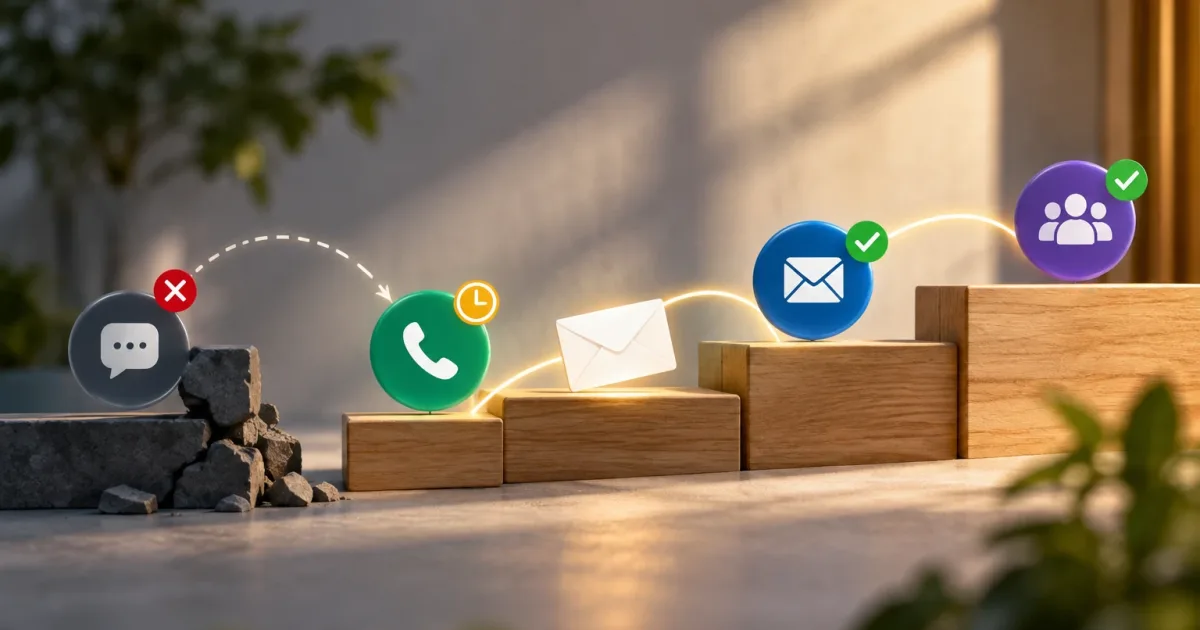
An important message does not always arrive through its intended channel. An email may bounce, an SMS may remain undelivered, or a notification may not be available. When that happens, automatically switching to another channel may seem like a simple solution, but doing so without clear rules can lead to duplicate messages, confusion, or unauthorized communications.
A well-designed fallback does not mean sending the same thing everywhere. It is a policy that decides whether to retry, when to switch channels, and what information to record. To define it, you need to consider technical delivery status alongside urgency, message type, and the recipient’s preferences and permissions.
What it means to use a channel fallback

A fallback is a controlled transition from a primary communication channel to an alternative when the expected result is not achieved. For example, an application might try to send a notification and, if that channel is unavailable, consider another permitted channel. The switch should not be triggered by every delay, and it should not mean that every message is sent simultaneously.
The first decision is to define what “delivered” means. A request accepted by a provider, a message sent, and a delivery confirmation are different states. In addition, a technical confirmation does not necessarily prove that someone has read or understood the content. The policy should specify which signal triggers the fallback and what uncertainties remain.
It is also useful to distinguish the purpose of each communication. A security alert, a routine update, and a promotion do not have the same urgency or necessarily the same permissions. Fallback rules should be specific to each message category, rather than applied indiscriminately as a single global rule.
When to retry and when to switch channels
Before switching channels, classify the failure. A temporary error may be caused by an outage, a sending limit, or network delay. Another attempt after a defined wait may be reasonable if the message is still useful. By contrast, an invalid email address or a non-existent phone number points to a problem that is unlikely to be resolved by resending to the same destination.
Timing matters, too. For a non-urgent confirmation, waiting for a more conclusive signal can prevent an unnecessary fallback. For a time-sensitive action, a long wait may defeat the purpose of the alert. Define the maximum period during which the message remains useful, and stop attempts when that period expires.
A practical decision can follow this sequence:
- Identify the observed outcome: accepted, delivered, failed, pending, or unknown, based on the available signals.
- Classify the failure: temporary, permanent, or uncertain. If the signal does not distinguish between them, do not automatically treat it as a permanent failure.
- Check whether the message is still timely: determine whether it makes sense to send it after waiting or retrying.
- Choose an action: wait, retry, switch to a permitted channel, or stop the workflow.
Retries need limits and a defined wait period. Uncontrolled repetition can increase load and multiply notifications. If the provider does not return a reliable result, record the uncertainty and avoid assuming that delivery failed simply because no confirmation arrived.
How to weigh urgency, preferences, and permissions
Urgency helps determine how long to wait, but it does not override preferences or permissions. The rule should check whether the recipient may receive that type of message through the alternative channel. Having an email address or phone number on file does not, by itself, mean that any use is authorized.
Separate transactional communications from promotional ones and apply the relevant rules to each category. If the recipient has disabled a channel, or there is no valid basis for using it, the fallback should stop or use another authorized option. If no permissible alternative is available, it is better to record the failure than to disregard the person’s choice.
Consider the content, too. A message containing sensitive information should not be moved to a less suitable channel just because it is available. If the alternative channel has limited space, you may need to send a brief notice directing the recipient to an authenticated environment, provided that this workflow is appropriate. Do not automatically copy the entire message into a different channel.
For each message category, document a simple matrix: urgency, primary channel, authorized alternatives, wait time, and stop condition. This matrix makes decisions explicit and allows product, operations, and customer support teams to review exceptions before implementation.
How to prevent duplicate or contradictory messages
The greatest risk arises when the system cannot tell whether the first message arrived. If it starts the fallback while the original channel is still pending, the recipient may get both messages. For this reason, use a shared workflow state and define which component is authorized to advance, retry, or cancel it.
Associate attempts with a communication or business-event identifier. This makes it possible to link each send attempt to the same purpose and recognize that a technical retry is not a new communication. The logic should be idempotent: processing a signal or request again should not create additional sends without a deliberate decision.
Before activating the alternative, check whether the primary message was already delivered, whether an attempt is pending, and whether the information is still current. If the alternative has already been sent, do not return to the primary channel because of a delayed notification without first checking the current state. When an earlier message may be out of date, the new communication should clarify which action is valid rather than present conflicting instructions.
When delivery through the first channel cannot be confirmed, the right response depends on the impact of a duplicate compared with the impact of failing to notify. Make that decision for each message type. In some cases, waiting is best; in others, send a brief alternative that explains it is the same alert. There is no universal rule that eliminates risk, but the risk can be made explicit and limited.
What to record to understand the workflow
Records should make it possible to reconstruct why each decision was made without exposing more personal information than necessary. At a minimum, keep the communication identifier, message category, channel attempted, observed outcome, time of the switch, and reason that triggered it.
Also record whether the transition followed a permanent error, exhausted retries, a delay that exceeded the time limit, or a policy decision. Note the alternative channel selected and the final known status. Distinguish between “no confirmation” and “failed”: these are different situations and call for different responses from customer support and operations.
A consistent taxonomy helps answer specific questions: Did the provider report a rejection? Were all attempts exhausted? Was the channel unauthorized? Had the message expired? Avoid vague reasons such as “general error,” which make it harder to prioritize improvements. Limit access to records and set retention periods according to operational needs and applicable obligations.
How to test and review the policy

Before deploying a rule, test ordinary scenarios and exceptions: confirmed delivery, delay, permanent rejection, unknown response, changed preferences, no available alternative channel, and message expiration. Check both the system’s behavior and what the recipient sees, as well as what the customer support team can explain.
Monitor signals that reflect the full workflow: the share of messages that trigger a fallback, failures by channel, time to outcome, and cases with more than one send for the same purpose. Do not treat an increase in deliveries as success on its own. Compare it with duplicates, complaints, opt-outs, or support contacts when those data are available and relevant.
Review the policy after changes to providers, channels, preferences, or content. If failures are concentrated around a fixable cause, such as outdated contact details, switching channels may hide the problem instead of resolving it. Fallback is a safeguard against failures, not a substitute for the quality of the primary channel. A good rule makes clear when to act, when to wait, and when to stop, and enables teams to explain each transition without sending more than necessary.